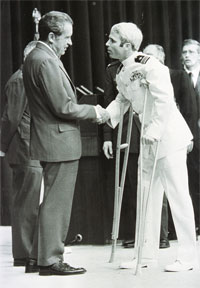
 Senator John McCain isn’t shy when it comes to talking about his experience as a prisoner of war in Vietnam. The first word in his Republican National Convention biographical film is "P.O.W." In an appearance on The Tonight Show with Jay Leno in late August, he answered a playful question about how many houses he owns by saying, "Could I just mention to you, Jay, at a moment of seriousness, I spent five and half years in a prison cell. I didn’t have a house. I didn’t have a kitchen table. I didn’t have a table. I didn’t have a chair."
Senator McCain isn’t the only one interested in his experiences. In the October Atlantic, Jeffrey Goldberg discusses how Senator McCain’s imprisonment shaped his views in his cover story about the candidate. Also this month, Men’s Vogue‘s features The Greatest Story Never Told, about Senator McCain and his cell mate, George "Bud" Day, by Corey Seymour.
But of all the stories of Senator McCain’s POW experience, the one that might prove most controversial is in the Sept. 17th edition of The Nation. Veteran investigative journalist Sydney Schanberg offers a report about how Senator McCain, while constantly reminding voters of his experience as a POW, has gone to great lengths to hide details of other prisoners’ lives—and deaths—in Vietnam. (A longer version of the story, complete with documents, can be found at The Nation Institute’s Web site.)
Mr. Schanberg, whose experience covering the Khmer Rouge’s destruction of Cambodia for The New York Times in the ’70s formed the basis for the movie The Killing Fields, writes:
The longer "director’s cut" version is well worth printing out for a long, thorough read.
